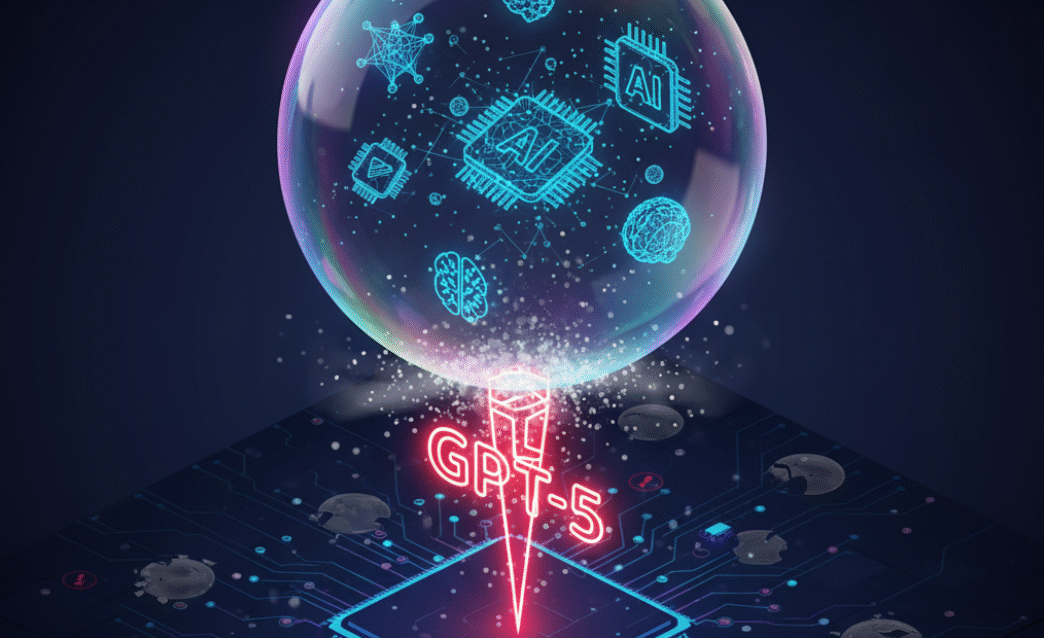

GPT-5 wasn’t the breakthrough everyone expected. It was more of a reality check. After two years of development, OpenAI delivered incremental improvements that signal a fundamental shift in AI progress.
The Scaling Wall
The core assumption driving AI investment, that bigger models equal better performance, has hit a wall. OpenAI’s internal “Orion” model showed diminishing returns, forcing the industry to pivot from building larger models to fine-tuning existing ones.
This marks the end of architectural innovation and the beginning of software optimization. Companies betting on exponential improvements need new timelines.
The Math Problem
The economics are brutal: $560 billion in AI capex over 18 months generated just about $35 billion in AI revenue. With 35% of U.S. market cap tied to seven AI-heavy tech giants, current investment levels look unsustainable.
Recent research from Apple and Arizona State reveals AI “reasoning” capabilities collapse outside training parameters, a gap between marketing promises and reality that creates real enterprise risk.
What’s Actually Coming
Forget AGI. We’re entering an era of useful but incremental tech tools. Think “smart software” rather than “electricity moment”, valuable for specific applications but not reshaping industries overnight.
Code generation and content summarization will improve. But wholesale job displacement and industry disruption fears are likely overblown.
The Pragmatic Path
Smart leaders should focus on proven use cases with clear ROI, not AGI moonshots. The AI revolution isn’t canceled, it’s just more evolutionary than the tech bros promised.
This valuation-obsessed approach leaves American AI companies exposed to China’s patient, strategic play, where capabilities remain largely hidden and long-term positioning trumps quarterly releases.
Companies adjusting expectations now will be better positioned when the technology eventually delivers on its big potential.